Location: Italy Campania Pompei
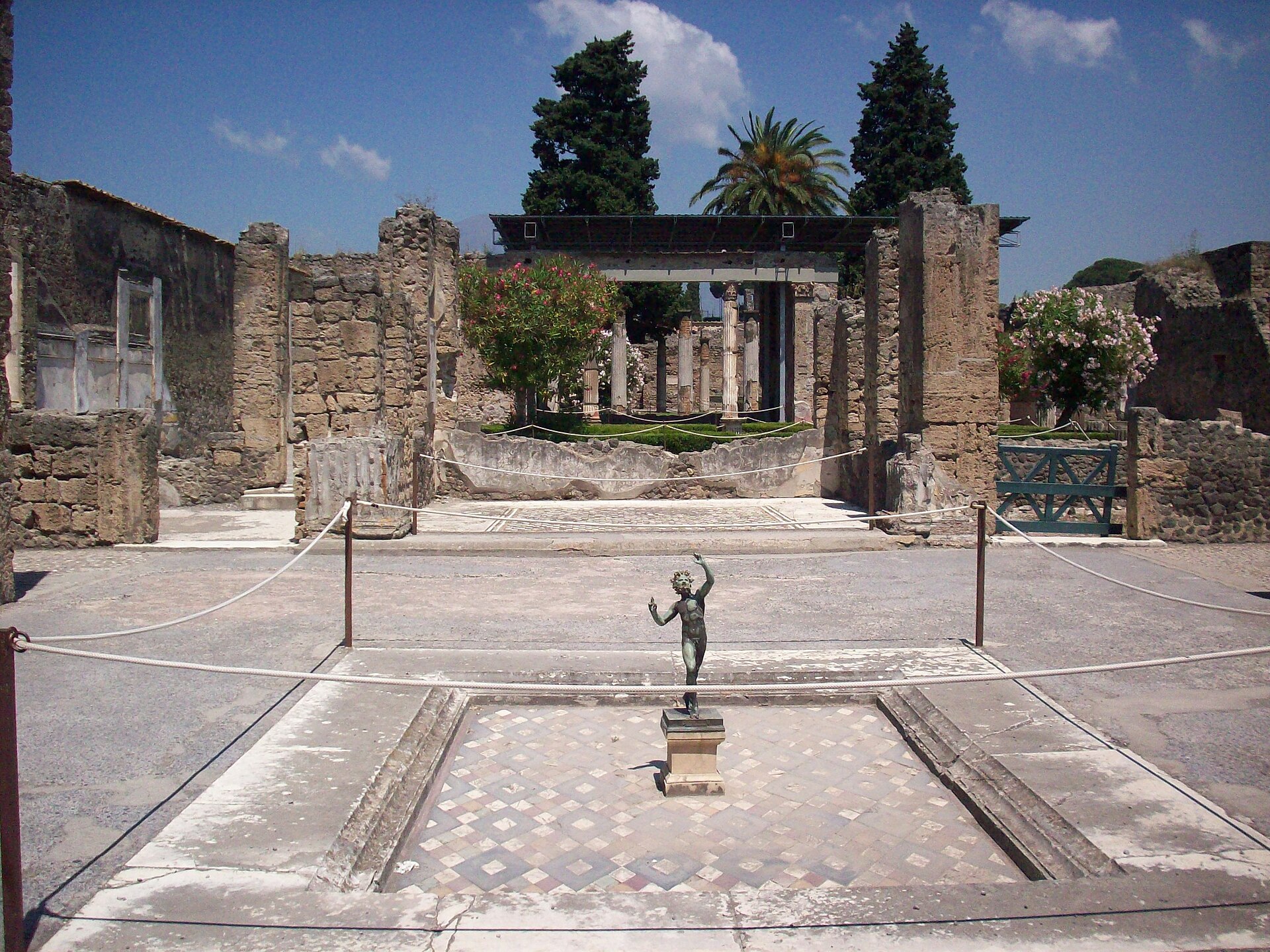
The largest private house in Pompeii – where the famous Alexander Mosaic and the bronze statue of the dancing faun that gave the house its name were found.
Interesting facts
- The Alexander Mosaic consists of around one million tesserae.
- The faun statue was found on 26 October 1830.
- Of the house's silver treasure, only four of originally 14 vessels survive.
- The entrance mosaic greets visitors with "HAVE" – "Hail to you".
Why visit
- The largest and most splendid house in Pompeii
- Where the famous Alexander Mosaic was found
- Easy to combine with the National Archaeological Museum in Naples, where the originals are displayed
At almost 3,000 square metres, the House of the Faun (Casa del Fauno) is the largest known private house in ancient Pompeii. It takes up nearly a whole city block – insula 12 of Regio VI – on the Via di Nola. It was built at the beginning of the 2nd century BC, still in the Samnite period, and generously remodelled by the end of that century: the older atrium house gained two colonnaded courtyards, an Ionic and a Doric peristyle.
Who owned the house is not certain. An inscription with the cognomen Saturninus points to the Satria family, a ring bearing the name Cassius to a family that married into it. The eruption of Vesuvius in AD 79 buried the house, and the ash preserved its decoration. It was excavated between 1830 and 1832.
The house is named after a small bronze statue of a dancing faun found on 26 October 1830 by the atrium’s water basin. On 24 October 1831 the Alexander Mosaic came to light in the floor of an exedra: it measures 5.82 by 3.13 metres, consists of around one million tesserae and shows Alexander the Great in battle against the Persian king Darius III. The statue and the mosaic are now on display in the National Archaeological Museum in Naples; copies stand in the house itself. At the entrance a mosaic greets visitors with the word “HAVE” – “Hail to you”.
History
Built at the beginning of the 2nd century BC, extended with two peristyles by the end of the century, buried by the eruption of Vesuvius in AD 79, excavated 1830–1832. The faun statue was found on 26 October 1830, the Alexander Mosaic on 24 October 1831.
Special features
Largest private house in Pompeii (almost 3,000 m²) with two atria and two peristyles. Copies of the bronze dancing faun and of the Alexander Mosaic, entrance mosaic "HAVE". The originals and further mosaics from the house, such as a Nile landscape, are in the National Archaeological Museum in Naples.
Practical information
- Suitable for
- Visitors interested in history and art, visitors to the Archaeological Park of Pompeii.
- Getting there
- In the Archaeological Park of Pompeii (Regio VI, insula 12). It can be visited as part of a visit to the park; please check opening hours and admission with the Archaeological Park of Pompeii.
Details may change. Please check current information with the operator before your visit.
Map
Opens an external route planner. Please check access and opening times before you set off.
Sources
- Wikipedia (en): House of the Faun
- Wikipedia (de): Haus des Fauns
- Wikipedia (de): Alexandermosaik
- Archaeological Park of Pompeii (official portal)
- Wikidata: Q1547308
Image: Porsche997SBS · CC BY-SA 3.0 · Wikimedia Commons
