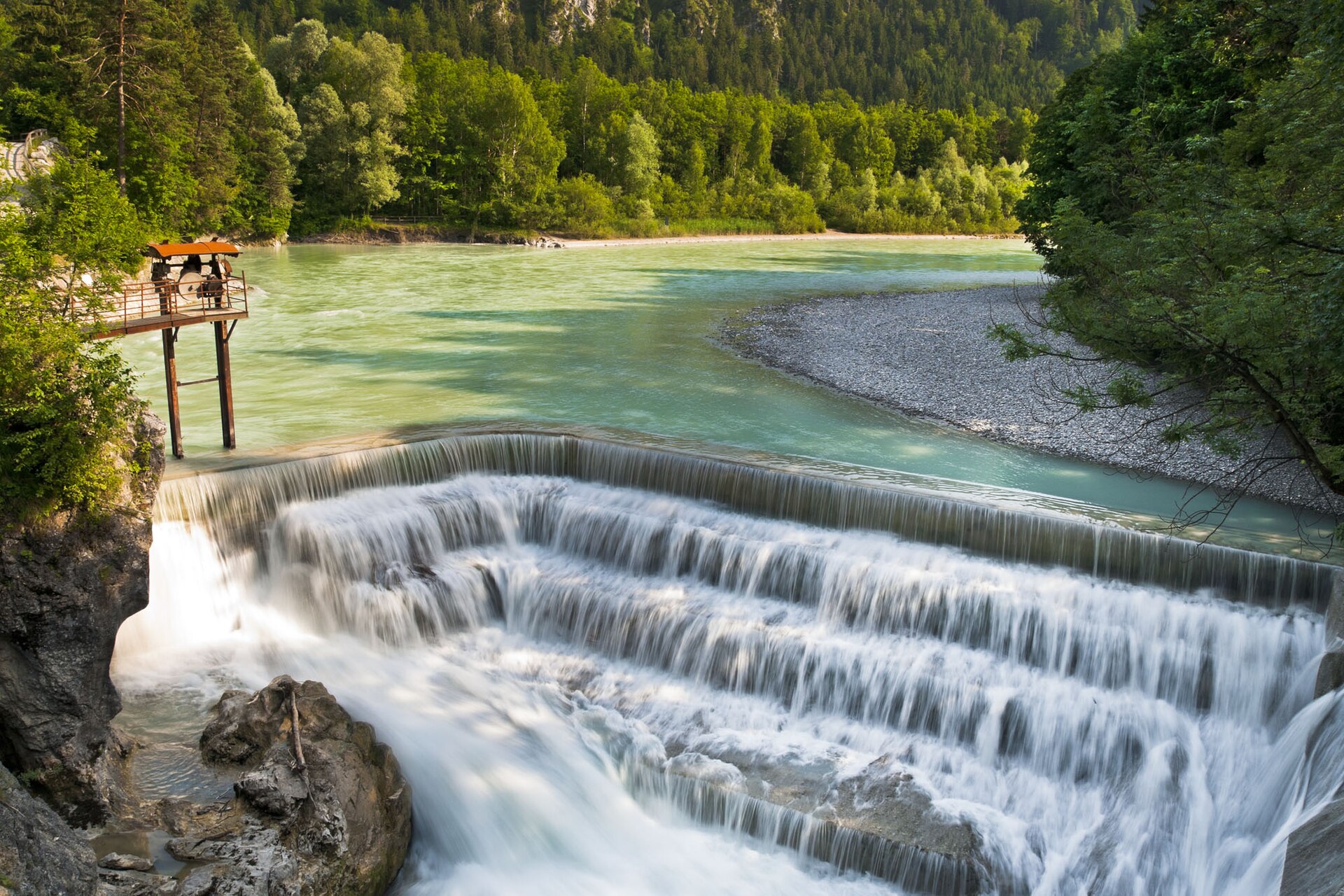
Location: Germany Bavaria Füssen
Waterfall on the River Lech at the edge of Füssen – just under eight metres high, with a gorge, the King Max footbridge and the legendary Magnustritt.
Interesting facts
- According to local tradition, the Magnustritt is the footprint of Saint Magnus, who is said to have leapt across the Lech while fleeing.
- The King Max footbridge has crossed the Lech Falls since 1895.
- The Lech Falls are one of the 100 most beautiful geotopes in Bavaria.
Why visit
- View into the Lech gorge from the King Max footbridge
- Geotope and natural monument on the edge of Füssen
- The Magnustritt and the bust of King Maximilian II
The Lech Falls (Lechfall, also called Mangfall) lie on the southern edge of Füssen, where the River Lech leaves the Northern Limestone Alps. Over a series of steps just under eight metres high and 49 metres wide, the river drops into a gorge about 150 metres long and a good 20 metres deep. The Lech has cut this gorge into Wetterstein limestone since the end of the Würm glaciation around 12,000 years ago.
The falls are not entirely natural in their present form: between 1784 and 1787 a weir and a diversion tunnel were built to use the water power. Since then the falls have consisted of three steps, the highest being the weir step of just over five metres. Minimum residual flows are set for the waterfall.
The King Max footbridge (König-Max-Steg) has crossed the falls since 1895. Above the gorge a bust of King Maximilian II stands in a niche, and on the east bank visitors are shown the so-called Magnustritt.
History
The gorge formed after the end of the Würm glaciation, when meltwater from the Lech glacier created a large lake reaching as far as Pfronten and the Lech cut into the Wetterstein limestone. The weir and a diversion tunnel for water power were built between 1784 and 1787. The King Max footbridge over the falls dates from 1895.
Special features
Three steps of 5.2 m, 1.8 m and less than 1 m across a width of 49 m; mean discharge about 65.8 m³/s. The falls and gorge are listed as a geotope and count among the 100 most beautiful geotopes in Bavaria; the gorge is also a natural monument.
Map
Opens an external route planner. Please check access and opening times before you set off.
Nearby
High Castle of Füssen
Füssen, Bavaria
0.6 km away
Late Gothic castle above Füssen's old town, once a seat of the bishops of Augsburg – known for the painted trompe-l'œil architecture in its courtyard.
Route
St. Mang’s Abbey
Füssen, Bavaria
0.6 km away
Former Benedictine abbey in Füssen's old town, rebuilt in Baroque style by Johann Jakob Herkomer – today home to the town hall, the town museum and the library.
Route
Faulenbach Valley
Füssen, Bavaria
1.1 km away
Protected karst valley near Füssen with the Mittersee and Obersee lakes, outdoor pools, a Kneipp facility and hiking trails – along the Faulenbach stream between the Alatsee and th…
Route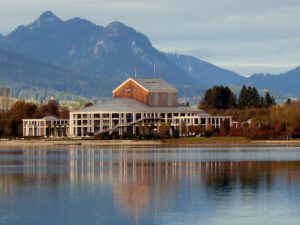
Festspielhaus Neuschwanstein
Füssen, Bavaria
2.9 km away
Musical theatre on the shore of the Forggensee in Füssen, opened in 2000 – its terrace looks across the lake to Neuschwanstein Castle, about four kilometres away.
Route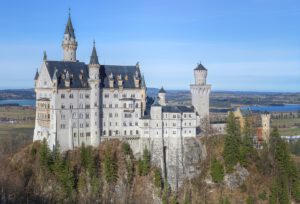
Neuschwanstein Castle
Schwangau, Bavaria
4.1 km away
King Ludwig II's unfinished castle on a rocky ridge above Hohenschwangau in the Bavarian Allgäu – built in Romanesque Revival style from 1869 and part of a UNESCO World Heritage Si…
Route
Sources
Image: Jan Harenburg · CC BY 4.0 · Wikimedia Commons
