Location: Germany Bavaria Schwangau
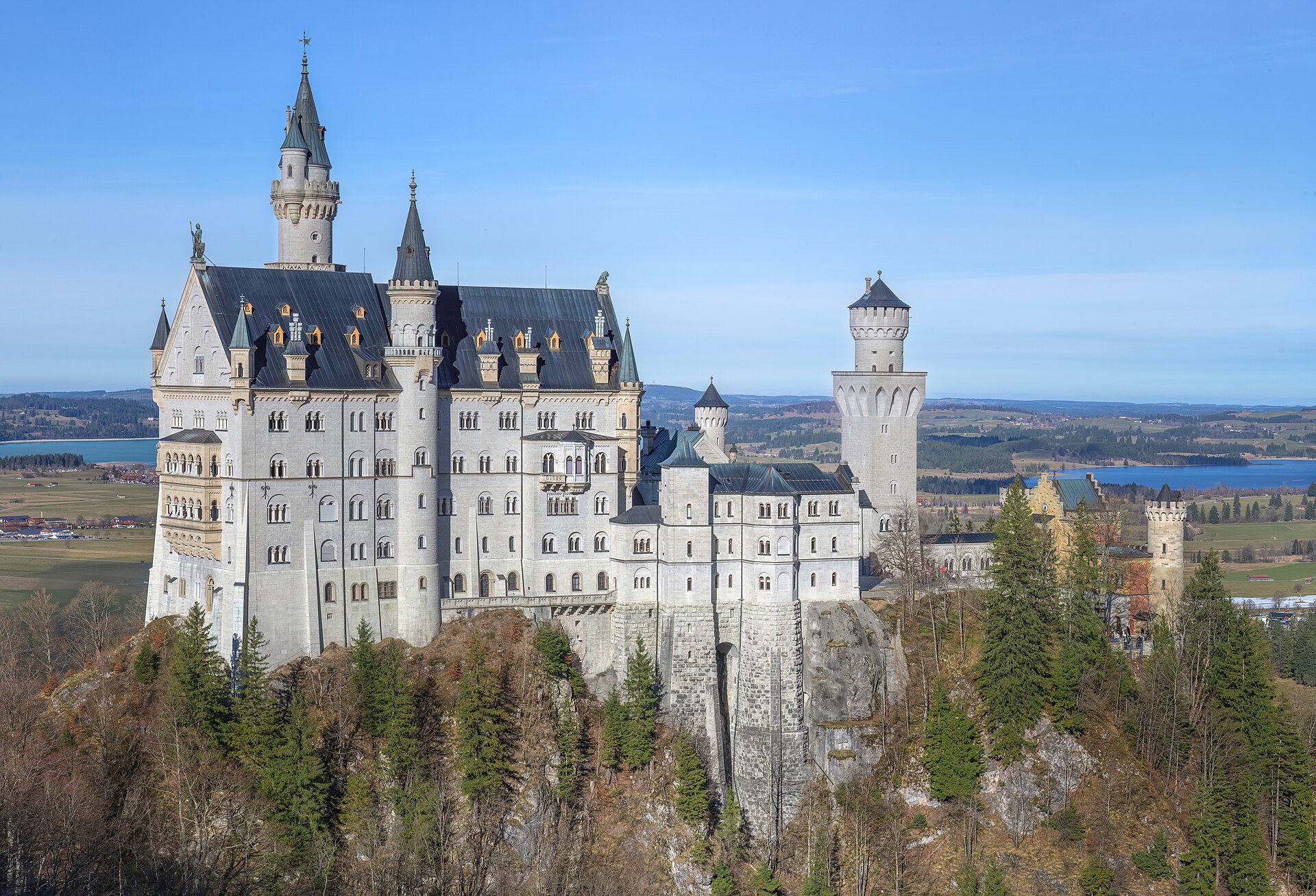
King Ludwig II's unfinished castle on a rocky ridge above Hohenschwangau in the Bavarian Allgäu – built in Romanesque Revival style from 1869 and part of a UNESCO World Heritage Site since 2025.
Interesting facts
- Ludwig II lived in the castle for a total of only 172 days.
- Richard Wagner, whose operas inspired the building, never set foot in the castle.
- The planned keep, about 90 metres high, was never built.
- Sleeping Beauty Castle at Disneyland in California was modelled on Neuschwanstein.
- The first concert in the Singers' Hall took place in 1933.
Why visit
- Romanesque Revival architecture and interiors from the time of Ludwig II
- View of the south façade from the Marienbrücke bridge above the Pöllat Gorge
- Easy to combine with neighbouring Hohenschwangau Castle and the Alpsee lake
Neuschwanstein Castle stands on a rocky ridge above Hohenschwangau, a village in the municipality of Schwangau in south-western Bavaria, a short distance from the town of Füssen. It was commissioned by King Ludwig II of Bavaria, who did not intend it as a seat of government but as a private retreat evoking the knights’ castles of the Middle Ages.
The first designs came from the stage designer Christian Jank. Construction was directed at first by the architect Eduard Riedel, from 1874 by Georg von Dollmann and from 1880 by Julius Hofmann. The foundation stone of the main building (the Palas) was laid on 5 September 1869. The castle is regarded as a major work of historicism in the Romanesque Revival style. Its models included the Wartburg near Eisenach and the stage worlds of Richard Wagner, above all the operas Tannhäuser and Lohengrin. Ludwig paid for the project from his personal fortune and with loans rather than from Bavarian public funds.
Neuschwanstein was never completed. When Ludwig II died in 1886, the planned keep and the chapel had not been built, and the Kemenate wing was only finished in simplified form by 1892. The king himself lived in the castle for a total of just 172 days. It was opened to visitors within weeks of his death, although he had wanted to keep it closed to the public.
Today the castle belongs to the Free State of Bavaria and is managed by the Bavarian Palace Administration. Since 2025 it has been part of the UNESCO World Heritage Site “The Palaces of King Ludwig II of Bavaria”. Well over one million people visit it every year.
History
Ludwig II had the castle built from 1869 on the site of two medieval castles, Vorderhohenschwangau and Hinterhohenschwangau. The construction was financed from the king's personal fortune and through loans, not from the Bavarian state treasury. After his death in 1886 the castle remained unfinished and was opened to visitors shortly afterwards.
Special features
A Romanesque Revival complex with gatehouse, Palas and Kemenate. Its best-known rooms are the Throne Room (about 20 × 12 metres and 13 metres high), modelled on the All Saints' Court Church of the Munich Residenz, and the Singers' Hall (27 × 10 metres), modelled on the hall of the Wartburg and the largest room in the castle.
Map
Opens an external route planner. Please check access and opening times before you set off.
Nearby
St. Mang’s Abbey
Füssen, Bavaria
3.9 km away
Former Benedictine abbey in Füssen's old town, rebuilt in Baroque style by Johann Jakob Herkomer – today home to the town hall, the town museum and the library.
Route
High Castle of Füssen
Füssen, Bavaria
4.0 km away
Late Gothic castle above Füssen's old town, once a seat of the bishops of Augsburg – known for the painted trompe-l'œil architecture in its courtyard.
Route
Lech Falls
Füssen, Bavaria
4.1 km away
Waterfall on the River Lech at the edge of Füssen – just under eight metres high, with a gorge, the King Max footbridge and the legendary Magnustritt.
Route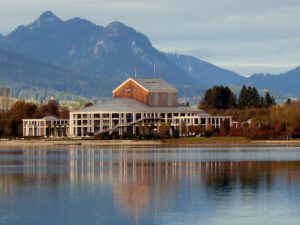
Festspielhaus Neuschwanstein
Füssen, Bavaria
4.4 km away
Musical theatre on the shore of the Forggensee in Füssen, opened in 2000 – its terrace looks across the lake to Neuschwanstein Castle, about four kilometres away.
Route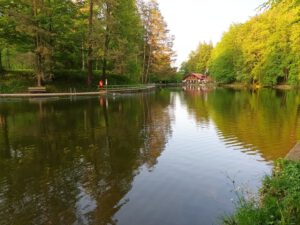
Faulenbach Valley
Füssen, Bavaria
5.2 km away
Protected karst valley near Füssen with the Mittersee and Obersee lakes, outdoor pools, a Kneipp facility and hiking trails – along the Faulenbach stream between the Alatsee and th…
Route
Sources
Image: Wilfredor · CC0 · Wikimedia Commons
