Location: Germany Bavaria Füssen
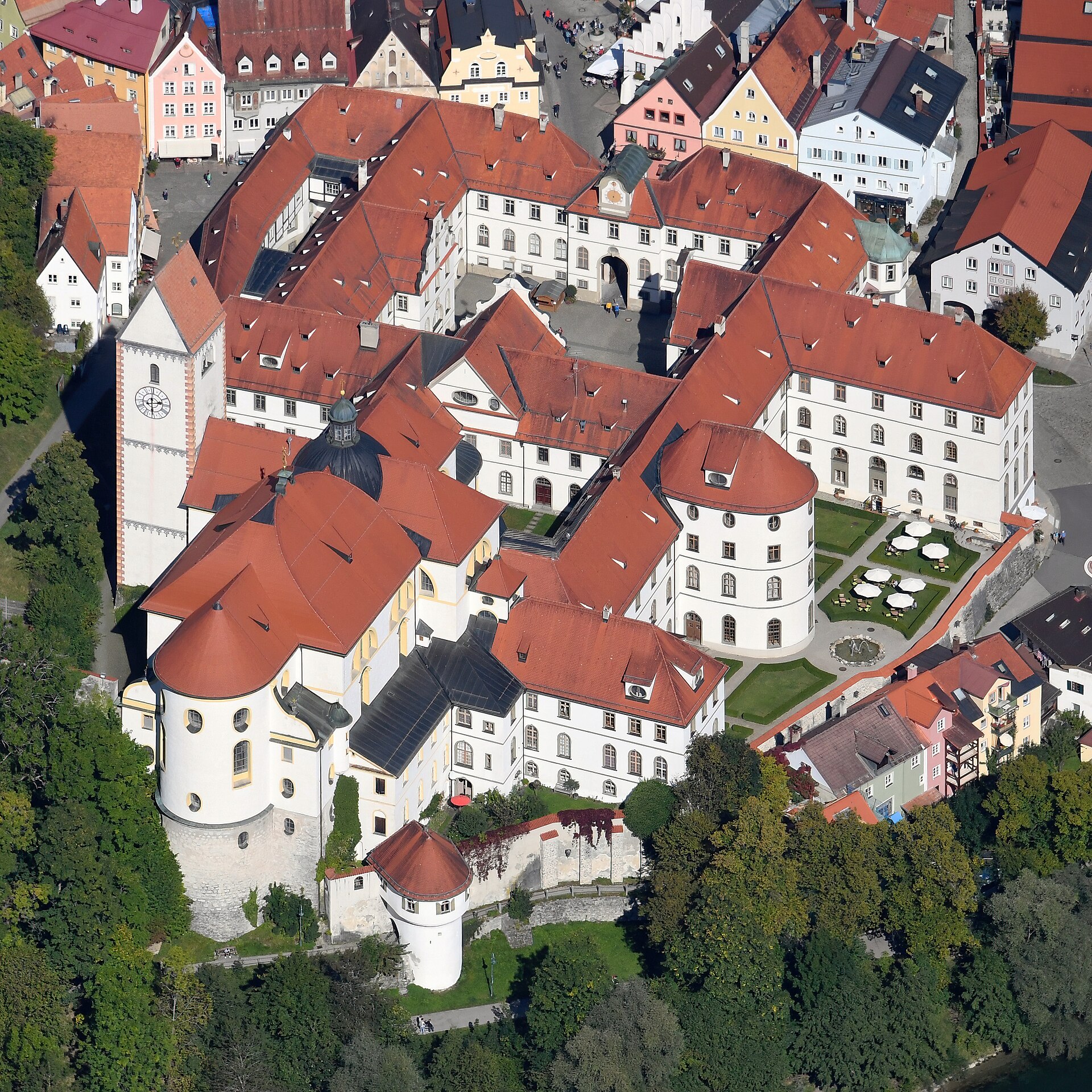
Former Benedictine abbey in Füssen's old town, rebuilt in Baroque style by Johann Jakob Herkomer – today home to the town hall, the town museum and the library.
Interesting facts
- The Füssen Dance of Death in St. Anne's Chapel was painted by Jakob Hiebeler in 1602 and consists of twenty images on ten wooden panels.
- Concerts have been held in the Princes' Hall since 1951.
- After 1803 the abbey library passed to the House of Oettingen-Wallerstein; most of it is now held by Augsburg University Library.
Why visit
- Baroque abbey complex in the heart of Füssen's old town
- State rooms and local history in the Füssen town museum
- The Füssen Dance of Death from 1602
The former Benedictine abbey of St. Mang stands in the old town of Füssen on the River Lech. It traces its origins to the hermit Magnus, who built a cell and an oratory here. In the first half of the 9th century this became a proprietary monastery of the bishops of Augsburg. Its position on the Roman Via Claudia Augusta and at the narrow Füssen pass gave the site strategic importance from early on.
The abbey’s present appearance is the result of a Baroque rebuilding carried out between 1696 and 1726 by the master builder Johann Jakob Herkomer. The monastery was dissolved during secularisation in 1802/1803, and the town of Füssen has owned the complex since 1909.
Today the north wing houses the town hall and the south wing the Füssen town museum, including the Baroque state rooms, as well as the town library. The former abbey church has served as the town’s parish church since the 19th century.
History
The hermit Magnus's cell grew into a monastery of the bishops of Augsburg in the first half of the 9th century. The complex was rebuilt in Baroque style between 1696 and 1726. At the end of 1802 the House of Oettingen-Wallerstein took possession, and in early 1803 the community was dissolved. The town of Füssen acquired the complex in 1909.
Special features
Highlights include the Princes' Hall (also called the Imperial Hall) with ceiling frescoes by Franz Georg Hermann, the oval library of 1719 and St. Anne's Chapel with the Füssen Dance of Death.
Map
Opens an external route planner. Please check access and opening times before you set off.
Nearby
High Castle of Füssen
Füssen, Bavaria
0.1 km away
Late Gothic castle above Füssen's old town, once a seat of the bishops of Augsburg – known for the painted trompe-l'œil architecture in its courtyard.
Route
Lech Falls
Füssen, Bavaria
0.6 km away
Waterfall on the River Lech at the edge of Füssen – just under eight metres high, with a gorge, the King Max footbridge and the legendary Magnustritt.
Route
Faulenbach Valley
Füssen, Bavaria
1.5 km away
Protected karst valley near Füssen with the Mittersee and Obersee lakes, outdoor pools, a Kneipp facility and hiking trails – along the Faulenbach stream between the Alatsee and th…
Route
Festspielhaus Neuschwanstein
Füssen, Bavaria
2.3 km away
Musical theatre on the shore of the Forggensee in Füssen, opened in 2000 – its terrace looks across the lake to Neuschwanstein Castle, about four kilometres away.
Route
Neuschwanstein Castle
Schwangau, Bavaria
3.9 km away
King Ludwig II's unfinished castle on a rocky ridge above Hohenschwangau in the Bavarian Allgäu – built in Romanesque Revival style from 1869 and part of a UNESCO World Heritage Si…
Route
Sources
Image: Carsten Steger · CC BY-SA 4.0 · Wikimedia Commons
